Who I am, What I'm Doing, Surprises, Books and Hidden Women
An Initial Offering

Why I’m Doing This
I grew up in the 1950s and 60s in a thoroughly white, middle class suburb in Michigan – very “Leave it to Beaver” or perhaps more accurately “Father Knows Best” (for a while my mother’s favorite TV show). I had no idea that women had really done much of anything in the world, and no idea that lesbian women even existed. I remained in this state pretty much through college and on into the 1970s. In High School we were required to go over our class selections every year with our “counselor.” I recall him asking why I had signed up for Physics my senior year. “Why do you want to do that?” he said. “You’re a girl. Girls just get married and become housewives. You certainly won’t need to know anything about Physics.”1 I also remember a conversation with a classmate in college, also a senior year. She had some theater friends over to our suite one evening and after they left she said, “They wondered if you were a dyke...” My answer was “What’s that?” though hindsight tells me I totally was.
It wasn’t until the gay rights and feminist movements in the 1970s that I started learning that women had actually done things and that women could support and even love each other in every imaginable way. I have learned a good deal, but fifty odd years later I am still on a quest to learn more about women’s accomplishments and the lives and contributions of my sister lesbian women – and I want to pass on what I learn because I don’t want young women, especially young lesbian women, to grow up in the back of a dark closet. I would like to help them understand that they are capable of most anything, they can pursue whatever goals they would like, and they can be themselves and love whomever they want.
You might think that all of this has been taken care of – that the feminist movement solved the problem pretty well and the gay pride movement took care of the bits the feminists may have missed. But, alas, I think this to be untrue. Much has been said and done, but we do not want to go backwards as the men currently in power want us to do. We want to – I want to – continue with the forward movement taking us to more knowledge about our history, our capabilities, our value and our power.
I would, as I read and learn and write, focus entirely on the stories of women past and present, but there is also a need to address the piece about the current misogynist, racist, homophobic, transphobic people who have inserted themselves in positions of power and want to turn the cultural clock backwards. These people (mostly white, cis-gender men) seem to want to erase the cultural progress we as a country have made since the 1950s and 60s and 70s. Of course that progress towards real equality and celebration of diversity, though very significant, has not come to the desired endpoint. There is still a great deal to do.
As an example (and there are many, many more), in the 2024-2025 US Congress women made up 28% of the members (House and Senate) but were 51% of the national population. The ninety first Congress (1969-1970) had 11 women (2.0%) so that is clearly a good deal of progress, but the job for equality and systemic equity is clearly not finished 2
How We Got Here
A word here about how people look at statistics like the ones about women in the US Congress given above. Some people will, as I do, look at those facts and say “there is inequality and prejudice and harm here. This must change.” Other people might look at the same numbers and say, “Women aren’t as good at politics as men, people just don’t vote for them because of that.” or “Women aren’t as interested in politics as men, so they don’t run for office.” 3
My thinking is that this is about underlying assumptions. Deeply held and deeply seated beliefs about the world that we all have, but to which we pay little attention because they feel like truths to us. These are the life philosophies that we develop at such a young age that we did not even have language to talk about them or think about them. They are seeming axioms such as “the world is a safe place” or “the world is a dangerous place” or “I am good” or “I am useless.” They are our infant and toddler interpretations of the world around us and as such they are buried very deep. 4
These deeply held beliefs can be influenced later by communication, verbal or nonverbal, with family and others and make up our shared reality. So, I come to the statistic that 28% of Congress is made up of women while women make up 52% of the adult population with the deeply held view that people, male or female, are essentially the same in terms of cognition, intelligence and interests, which leads me to the conclusion that given equal opportunity and systemic equity there would be an equal number of men and women in Congress.
Now my opposition and I are at loggerheads. We cannot agree because we are starting from different “truths.” This is where data become very important. Vital. Imperative. This is why I cringe when people such as Donald Trump say “It’s just common sense! Everybody with common sense can see it.” Not true. Your common sense is my nonsense. To get through this impasse we must look to data, and if we do one of these two beliefs will be debunked.
Of course the final argument from my opposition will be “but that is how God wants it to be.” but that is for another day.
What Else Do I Want to Do?
As I read and learn I find lots of interesting asides (rabbit holes, shall we say) that I would like to share with you. These include books I discover and find interesting, writers or facts that surprise me to a “Whoa!!!” level and quotations that I find inspiring, pithy, profound, humorous or disturbing.
This leaves me with an organizational problem. How do I weave together writing about so many issues and foci? I here will take a cue from Kareem Abdul-Jabbar’s substack with great gratitude to him for what he writes and how he writes it. As you will see if you scroll down, I am using section headings as he does to organize content. This also makes it easier for you to choose which parts you want to read and which you don’t.
Imagine My Surprise!
The bit of information that surprised me most this week came when I was reading an essay by a fellow named Keith Williams in a book about women writers of the 1930s. 5 There I found Katharine Burdekin who published a book, Swastika Night, in 1937 (12 years before George Orwell published 1984). In her book Burdekin not only predates Orwell in his warning about Fascism and Totalitarianism, but she appears to have seriously predated Margaret Atwood whose Handmaid’s Tale was published in 1985. Williams writes that Burdekin identified “…Fascist ideology not as a historical aberration but as an extreme reaction against the idea of progress in human equality, rooted in an ancient tradition of misogyny.” (p. 151)
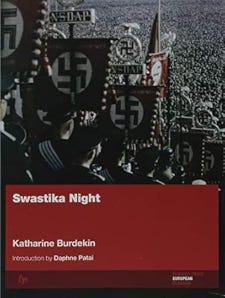
The blurb for the book on the Thriftbooks website (where the book is available) states that it
... projects a totally male-controlled fascist world that has eliminated women as we know them. Women are breeders, kept as cattle, while men in this post-Hitlerian world are embittered automatons, fearful of all feelings, having abolished all history, education, creativity, books, and art. The plot centers on a “misfit” who asks, “How could this have happened?” 6
Pretty timely and appropriate for what is going on in now, especially in the United States!
So Many Books, So Little Time
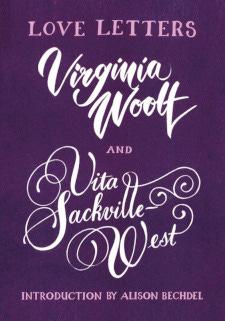
I have been pretty much retired since the pandemic (if semi-retired means working half time, I am maybe nano-retired and working as a psychologist about 10% of the time). So there is plenty of time for the shelves and shelves of books that surround me. My most enjoyable read recently has been Love Letters by Virginia Woolf and Vita Sackville-West with an introduction by Alison Bechdel (Vintage Classics, 2021). Who knew!? as they say. I suppose a lot of people knew, but no one was talking about this when I was in English Lit class in college!
Another book for fun, reflection and inspiration is from Gloria Steinem (2019) The Truth Will Set You Free, But First It Will Piss You Off. NY: Random House/Penguin.
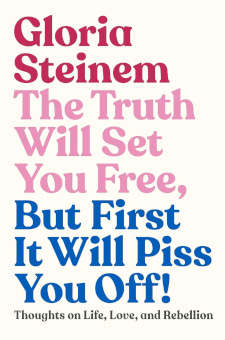
You’ve gotta have this on your bookshelf if just for the title! But it is more than that. It is a book of quotations from Steinem’s speeches, articles and books which are grouped in chapters with different foci: Families Born and Chosen, Changing Aging, Work Is Not a Four-Letter Word, and so on. She also includes quotes from people she admires like bel hooks, Audre Lorde, Adrienne Rich and Shirley Chisholm.
The following quote from Steinham struck me as entirely appropriate given what I am doing here:
What ever you want to do, just do it. Making a damn fool of yourself is essential. (p.127)
As I look through Steinem’s book I am reminded of a quote that was on a T- shirt I purchased in the early 1980s at a women’s book store in Cambridge, MA. It said (with illustration): A woman without a man is like a fish without a bicycle.
I wore it in my small-ish town, working class neighborhood and the very striking result was that all of the women of the neighborhood laughed heartily, while the men (their husbands) got very confused looks on their faces and said “that doesn’t make any sense...” No more need be said.
Out of the Shadows
One of the main purposes of my writing is to write about women – historic or current, unheralded or once recognized – who have made an important contribution, but seem to be ignored or buried or otherwise relegated to the dust bin of history. As well as posting here, I have also profiled some of these women on my website at chriscooperphd.com .
I will begin here with Mary Church Terrell (1863 - 1964) who was an African American woman born in Memphis, TN to Robert Church, a real estate investor and his wife Louisa Ayers who owned and ran a hair salon. Mary’s parents sent her at the age of eight to the Antioch College Model School in Ohio in order to get a better education than Memphis could provide. After graduation from that school, Mary attended Oberlin College, also in Ohio, where she earned an undergraduate degree in Classics in 1884, and a graduate degree in Education in 1888. She then taught at Wilberforce College in Xenia, Ohio, and then relocated to Washington, DC in 1887 to teach at the M Street High School. Somewhere in there she also traveled in Europe and became fluent in multiple languages.
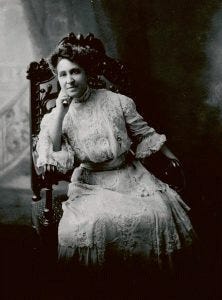
After her marriage to Robert Terrell, Mary (pictured above7) was expected to leave her job and focus on family and social issues. Among her many activities, she worked with the American Suffragist movement and tried to convince its white leaders of the importance of including Black women – not an easy sell. In addition, Mary was an organizer and speaker and brought many Black women’s organizations together to work against segregation and lynching and for the vote for women.
Mary became a prominent social activist and was one of the well-known leaders to endorse the NAACP at its founding in 1909 and then helped found the Washington, D.C. branch. In addition, she was the first president of the National Association of Colored Women, and the first black woman appointed to the District of Columbia Board of Education.
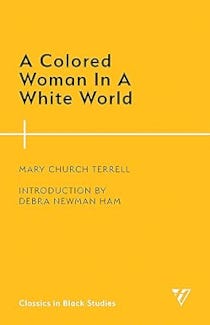
In 1940 Terrell, at the age of seventy-seven, published a memoir, A Colored Woman in a White World which is again available (Introduction by Debra Newman Ham, published by Roman and Littlefield in the series Classics in Black Studies, 2020. ISBN 978-1538145975)
Mary Terrell remained involved in political activism all her life. For example, in 1946, when she was eighty-three years old, Mary applied to reinstate her lapsed membership in the American Association of University Women (AAUP). Her application was denied because of her race, and she sued until her membership was reinstated in 1948. The organization also changed its policies at that time to allow members of color.
Mary died at the age of ninety-one in 1954 – shortly after the passage of Brown v The Board of Education which hopefully gave her a sense of progress and hope.
More information can be found online at the sites listed below.
The National Woman’s History Museum (Michals, Debra. “Mary Church Terrell.” National Women’s History Museum. National Women’s History Museum, 2017. Accessed 2 March 2025.)
Smithsonian National Museum of African American History and Culture
Parting Notes
I hope you have enjoyed at least parts of this post and/or found some of it interesting. Please feel free to leave comments. I will read them. Also let me know if there are particular things that you might want to see here.
My intention is to publish here once a week, but I am just getting started with this project, so patience is always appreciated!
Of course I did take Physics, was the only girl in the class, got a fabulous college recommendation letter from the teacher and landed in college thinking I wanted to be a Physics major.
Statistics obtained from Pew Research and the Congressional Research Service (2018) which can be downloaded from https://www.congress.gov › crs_external_products › R › PDF › R43244 › R43244.24.pdf
Many of you may recognize this latter statement as the same one used when women were and are fighting for equal funding and opportunity in women’s athletics. “We don’t fund women’s sports because women aren’t interested in being athletes.” or “We don’t fund women’s sports because no one, male or female, wants to watch women play basketball / tennis / hockey.” Turns out that once Title IX of the Federal Education Amendments was passed in 1972 and women’s sports were given more equal funding and footing women showed themselves to be very interested in athletics. Currently women’s sports are watched by many people who pay for tickets and support teams on both the college and professional levels.
Williams, Keith (1999) “Back from the Future: Katherine Burdekin and Science Fiction in the 1930s,” in Maroula Joannou (Ed.) Women Writers of the 1930s: Gender, Politics and History. Edinburgh: Edinburgh University Press, pp 151-164.
Swastika Night at Thrift Books
Photo in the public domain: Wikimedia Commons
Great intro to your Substack! And I’m looking forward to reading more of your writing!